Best IPTV Panel: A Complete Guide to Choosing the Right Management System in 2026
One of the most important decisions an IPTV company owner will make is which IPTV panel to use. It influences the dependability of your streams, the simplicity with which you handle customers, the efficiency with which your platform expands, and most crucially, whether your business rests on solid legal foundation. This manual covers what an IPTV panel really is, the characteristics that distinguish a professional grade system from an amateur one, and the questions you ought to be asking prior to signing on with any provider.
What Is an IPTV Panel, Exactly?
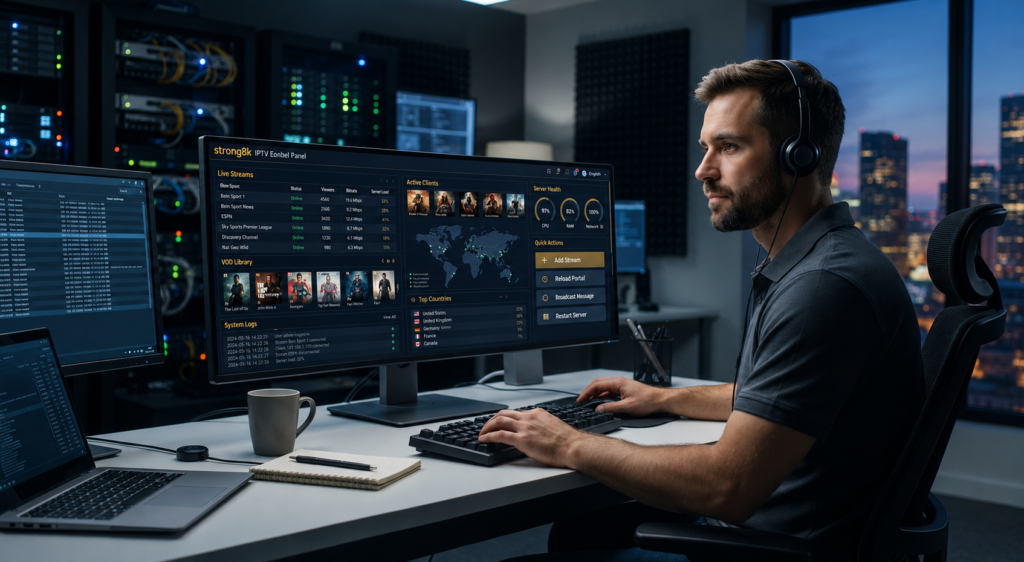
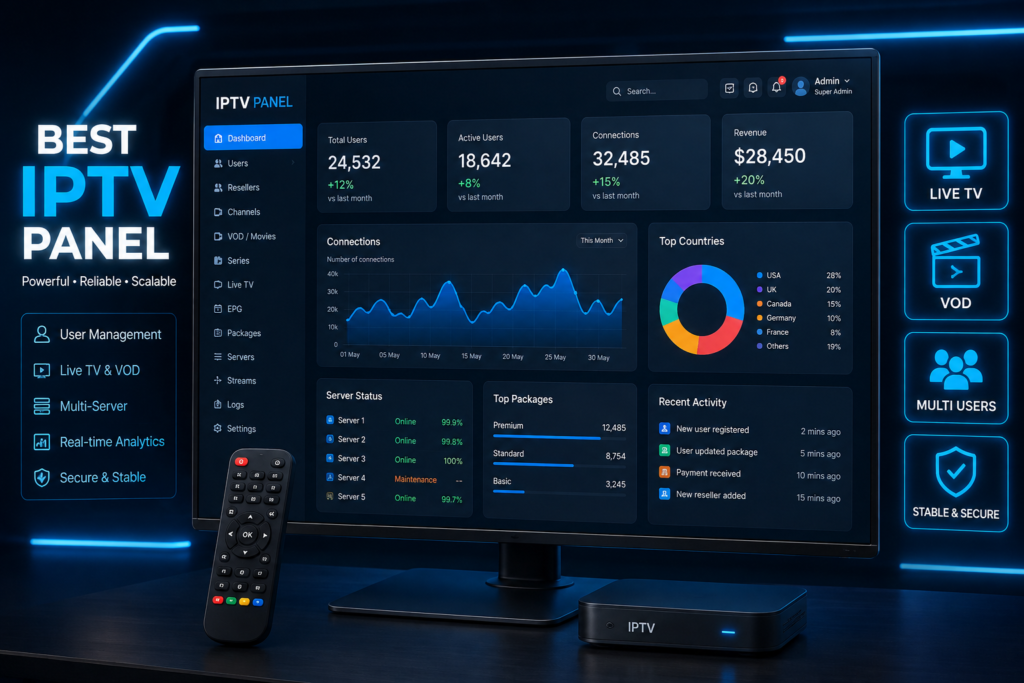
The administrative backend for controlling your streaming infrastructure and audience is known as an IPTV panel. Consider it the control center; here you add channels, handle user accounts, establish subscription levels, monitor server load, produce credentials, and keep an eye on billing. The panel itself does not produce videos; rather, it coordinates, distributes, and manages access to a previously appropriately licensed content stream.
Most panels are constructed on a client-server architecture. Streaming sources include encoders, transcoders, or content delivery networks Conversely, the end user application, an app on a smart TV, set top box, or media player, uses a protocol like Xtream Codes API, M3U playlists, or HLS to connect to the panel The panel controls authentication, session constraints, electronic program guides (EPG), and sometimes analytics in addition to that connection.
Since the panel is the operational center of every IPTV company, its quality has a disproportionate impact on everything downstream: buffering complaints, account theft, billing errors, even legal exposure all trace back to the level of construction and management of the panel.
Who Actually Uses IPTV Panels?
It’s worth being specific here, because the term gets used loosely. Legitimate use cases include:
- Hotels and hospitality groups distributing licensed cable and streaming content to guest rooms through a centralized system.
- Telecom and ISP operators offering IPTV as part of a bundled internet/television package, under proper broadcast agreements.
- Corporate and educational institutions running internal video distribution for training or campus content.
- Licensed content aggregators who have direct agreements with channel owners or studios to redistribute their programming digitally.
The first consideration could be summarized as follows: the most important question for anyone who is acquiring or building a panel is not how many channels are possible to support; rather, the foremost question is whether one has the rights to redistribute the content. A panel that has a good dashboard and stable uptime isn’t any good if it is utilized to deliver unauthorized content. Copyright holders and regulators from a good number of countries are taking legal actions not only against companies that are providing unlicensed IPTV services but also against certain resellers or subscribers. Before taking a look at any of technical features presented below, make sure you are familiar with the licensing of the content chain.
Core Features That Separate a Strong Panel from a Weak One
1. Stream Stability and Load Management
A panel’s real-world value is measured in uptime and buffering rates, not in the number of features listed on a sales page. Look for:
- Load balancing across multiple servers, so no single node gets overwhelmed during peak viewing hours (evenings, major sporting events).
- Automatic failover, where the system reroutes users to a backup stream if a primary server goes down.
- Adaptive bitrate streaming, which adjusts video quality in real time based on a viewer’s connection speed, reducing buffering without manual intervention.
- Geographically distributed CDN support, which matters enormously if your subscriber base spans multiple countries or regions latency compounds quickly over distance.
2. User and Reseller Management
If you plan to operate at any scale, granular account controls are non-negotiable:
- Tiered permission levels (admin, sub-reseller, end user) so you can delegate parts of the business without handing over full control.
- Credit or line-based systems for resellers, letting you cap how many subscriptions a given reseller can generate.
- Connection limits per account, which prevents a single credential from being shared across dozens of devices simultaneously a major source of both revenue leakage and security risk.
- Device and MAC address binding, tying a subscription to specific hardware to reduce credential sharing.
3. EPG (Electronic Program Guide) Quality
Having a good and efficient program guide is one of the most ignored aspects of customer retention. A guide that allows for easy import of EPG (with XMLTV being the industry standard), automatic change of time zones, and even customization of the guide for every channels will seem much more professional to subscribers than one that just has a list of channels.
4. Security Architecture
This is where many low-cost panels cut corners, and where the cost shows up later:
- Encrypted authentication tokens rather than static, reusable credentials.
- Rate limiting and brute-force protection on login endpoints.
- Regular security patching an unmaintained panel is a growing liability, since older Xtream-Codes-style panels in particular have a well documented history of being exploited.
- Two-factor authentication for admin and reseller accounts.
- Audit logging, so you can trace exactly who changed what and when.
5. Billing and Payment Integration
A system that joins to payment processors, creates invoices automatically, and manages renewals or expirations without the need for manual monitoring via spreadsheets will save a lot of labor time when the number of subscriptions grows Make sure recurring billing is integrally built into the system, the payments can be accepted in different currencies if necessary, and users receive clear expiration notifications.
6. Analytics and Reporting
Good panels give you visibility into:
- Concurrent viewer counts by channel and by time of day
- Server bandwidth consumption trends
- Churn and renewal rates
- Most-watched content, which can inform your licensing and content-acquisition decisions
Without this data, you’re operating blind scaling infrastructure reactively instead of proactively.
7. Multi-Device App Support
Users require a consistent experience across their preferred device, be it a smart TV, phone, tablet, or set top box. Standard panels (M3U8, Xtream API) work best with most players available in the market, so check that the panel you are going to use has a proper documented API for your developers to code upon if you are using your branded application.
Questions to Ask Before Choosing a Panel Provider
- What’s the actual uptime history, backed by data — not marketing claims? Ask for real uptime logs or third-party monitoring reports, not a number on a landing page.
- How is customer data stored and secured? If subscriber payment information touches the panel, you need clear answers on encryption and compliance.
- What happens if the provider shuts down? Panels tied to a single vendor with no data export options can leave you stranded. Prioritize systems that let you export your subscriber and billing data in a standard format.
- Is the licensing model transparent? Understand exactly what you’re paying for per server, per user, or flat licensing and whether costs scale predictably as you grow.
- What does support response time actually look like? A panel that goes down during a major live event with no support available for six hours will cost you subscribers permanently.
- Is the content supply chain licensed? This bears repeating because it’s the single biggest risk factor in this industry. A technically excellent panel built on unlicensed content is a business built on a legal time bomb.
Common Mistakes IPTV Operators Make
- Over-indexing on channel count. A panel advertising “20,000 channels” is a red flag more often than a selling point it typically signals aggregated, unlicensed content rather than a curated, rights cleared catalog.
- Ignoring server geography. Hosting all infrastructure in one location while serving a global audience guarantees latency complaints.
- Underestimating support load. As your subscriber base grows, so does your support ticket volume. Panels with self-service tools (password resets, device re-registration, automated renewal reminders) reduce this burden significantly.
- Skipping redundancy planning. A single point of failure one server, one payment processor, one panel vendor is an unnecessary risk that a modest investment in redundancy can eliminate.
- Neglecting the legal review. Many operators treat licensing as an afterthought rather than the foundation the entire business rests on.
The Legal and Regulatory Landscape
In recent years, regulatory scrutiny directed toward unauthorized distribution of IPTV has increased across North American, and European as well as some areas in Asia Enforcement actions emphasized not only the operators of the unauthorized panels but increasingly, resellers as well as paying subscribers of illegal IPTV services Following suitability of an operator’s legitimacy helps in securing legitimacy in the market and maximizing profitability of the copyrighted content in a time-efficient manner.
Conclusion
The greatest IPTV panel is the one that mixes reliable infrastructure (load balancing, failover, adaptive streaming), strong security practices, clear invoicing, and real data portability, all founded on a well licensed content supply chain, not the one with the flashiest dashboard or the greatest advertised channel count Technical brilliance and legal legitimacy are not opposing concerns; they are two sides of the same sustainable firm Operators who treat licensing as a checkbox rather than a foundation tend to create enterprises that appear prosperous right up until they are not Begin with the legal question, then assess the technology, not the other way around.
When assessing certain panel software, seek actual uptime statistics, pose pointed queries regarding data ownership and exportability, and make sure to have written documentation of the licensing rights for the information you will be sharing. Most of the choices not meant to last will be filtered out by those three processes.